

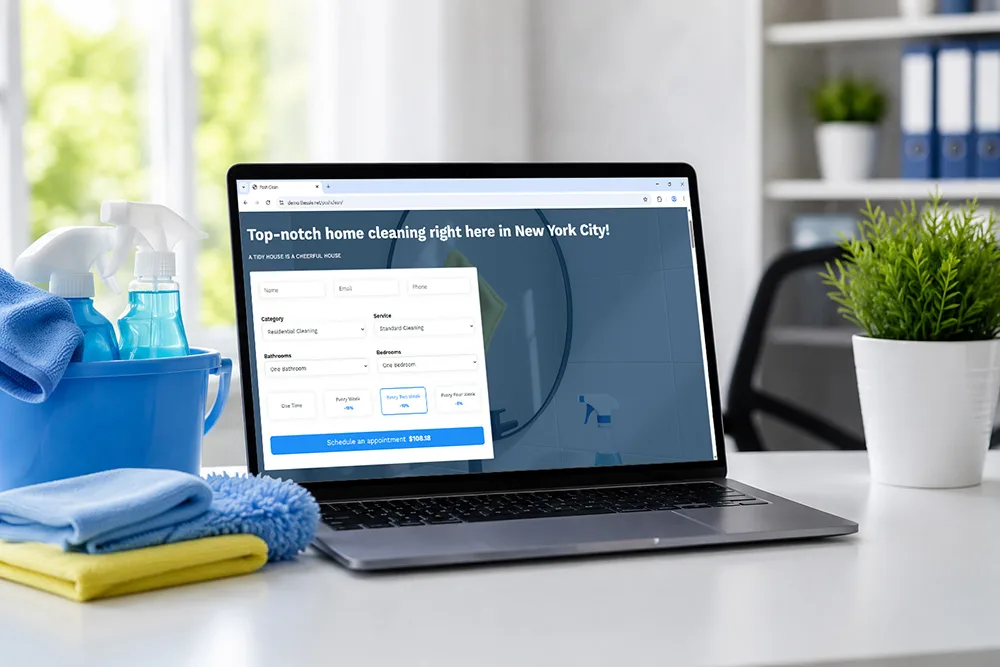
If you own a cleaning business, it is easy to get distracted by the wrong part of a website.
You look at colors. You look at logo placement. You look at whether a site feels modern. Those things matter, but they are not the reason a cleaning website wins business. A website wins when a visitor lands on it and quickly understands three things: what you do, why they should trust you, and what they should do next.
That is why the best cleaning business website examples are useful. Not because you should copy them section by section, but because they show you what good structure looks like. The strongest sites make the offer obvious, reduce hesitation, and create a clean path to a quote, call, or booking.
If you are reviewing examples before you redesign or launch your site, do not ask, “Does this look nice?” Ask, “Would this make the right customer take action?”
What a strong cleaning website example should teach you
A good example should teach you how to think, not just what to imitate.
The first lesson is clarity. A visitor should instantly know whether you clean homes, offices, move-out properties, or all three. General language is one of the biggest reasons small service-business websites underperform. If your homepage says everything to everyone, it often feels vague to everyone.
The second lesson is trust. Cleaning is personal. People are inviting someone into their home or workplace. That means trust is not an extra section you add later. It has to be built in from the opening screen onward. Strong examples put proof next to the promise. They do not wait until the bottom of the page to mention experience, process, reliability, or what makes the company different.
The third lesson is momentum. A website example is not strong if it simply informs. It has to move the visitor. That might mean a call button, a quote form, a price anchor, a service-area prompt, or a “book now” path. The best sites make the next step feel obvious and low-friction.
The elements the best examples almost always share
A clear headline with a specific offer
A strong homepage does not lead with generic language like “quality solutions” or “we care about our customers.” It says what the business does and who it serves. “Recurring home cleaning,” “move-out cleaning,” or “office cleaning for local businesses” works better than fluffy brand language because it helps the visitor self-identify immediately.
A short path to trust
You do not need a fifty-line story at the top of the page. You need quick reasons to believe you. That can include a concise “why choose us” block, a short process explanation, visible service standards, or proof language that reduces anxiety. The point is to answer the silent question in the visitor’s head: “Can I trust these people to do what they say?”
Service pages or service sections that are actually useful
Weak sites bury service detail in one paragraph. Strong sites explain what is included, who the service is for, and when to choose it. If someone wants a deep clean, they should not have to guess whether that is part of the standard service. If someone wants commercial cleaning, they should not have to read a residential page to find out.
Local relevance
Cleaning businesses usually win locally, not nationally. The best website examples feel local. They speak to service areas naturally. They do not stuff city names everywhere, but they do make it obvious where the company works and who the offer is built for.
A visible next step
This is where many attractive websites fail. They have attractive sections but no strong conversion path. A good example shows the reader exactly what to do: request a quote, call now, view pricing, or book a service.
A mobile-friendly structure
A large share of local service traffic comes from phones. If a website only works when someone studies it on a desktop monitor, it is not a good example. Watch how strong sites handle short text blocks, buttons, forms, and contact options on smaller screens.
FAQs that remove friction
A FAQ is not filler. It is one of the best ways to answer objections before someone leaves. Good examples answer practical questions: what areas are served, whether supplies are included, how quotes work, and what happens after a form is submitted.
What to ignore when you study website examples
Do not get trapped by style without strategy.
A dramatic hero image is not the same thing as a good headline. A long page is not automatically a persuasive page. Fancy motion does not replace trust. Large image sections do not compensate for weak copy. And a beautiful site that makes it hard to request service is not a business asset. It is decoration.
Also be careful with copying competitors too literally. Their market, service model, and target customer may not match yours. The point of studying examples is to spot recurring patterns that work, not to reproduce someone else’s site word for word.
How to turn examples into a useful brief for your own site
The smartest way to use example sites is to turn them into a decision document.
As you review each example, write down what you like under a few categories: headline structure, trust elements, service presentation, lead capture, pricing language, FAQ quality, and visual tone. Then circle only the elements that support your actual business model.
If most of your revenue comes from recurring residential clients, your site should feel easy, trustworthy, and friction-free. If you focus on office or commercial work, your site needs stronger qualification, service explanation, and proof of reliability. If you are just starting out, the most important thing is not complexity. It is clarity.
That is the right outcome of studying examples: you stop collecting screenshots and start defining requirements. Once you know the requirements, you can build or choose a site that is meant to convert, not just impress.
If you want to see how that conversion layer works in practice, review how Thessie LBP LeadGen turns more website visitors into leads or contact us here to talk through your website goals.
FAQ
Not necessarily. You need enough structure to explain the offer clearly, build trust, and create a strong next step. A simple site can work well if the message is specific and the visitor does not have to hunt for answers.
That depends on your service model. For some cleaning businesses, visible pricing or “starting at” pricing builds trust. For others, a quote-first structure is more realistic. The key is to reduce uncertainty rather than force visitors to guess.
Yes. In fact, some of the best examples are not the flashiest. They are useful because the messaging is clear, the proof is believable, and the call to action is obvious.